LinkedIn China
2022
LinkedIn China Pivot Redesign
North Star App Redesign + MVP Launch (Career Help Community)
I designed the end-to-end North Star experience for the LinkedIn China app redesign, and shipped the first MVP module (Career Help Community) within a 3-month window.
Impact
+0.75%
WAU
283K
Opt-in (Career Help Community)
78%
78% 7D Conversation Rate (Opt-in users)
ROLE & TEAM
Product Design Lead
What I owned
- •Led product direction exploration and defined the North Star experience for the app redesign.
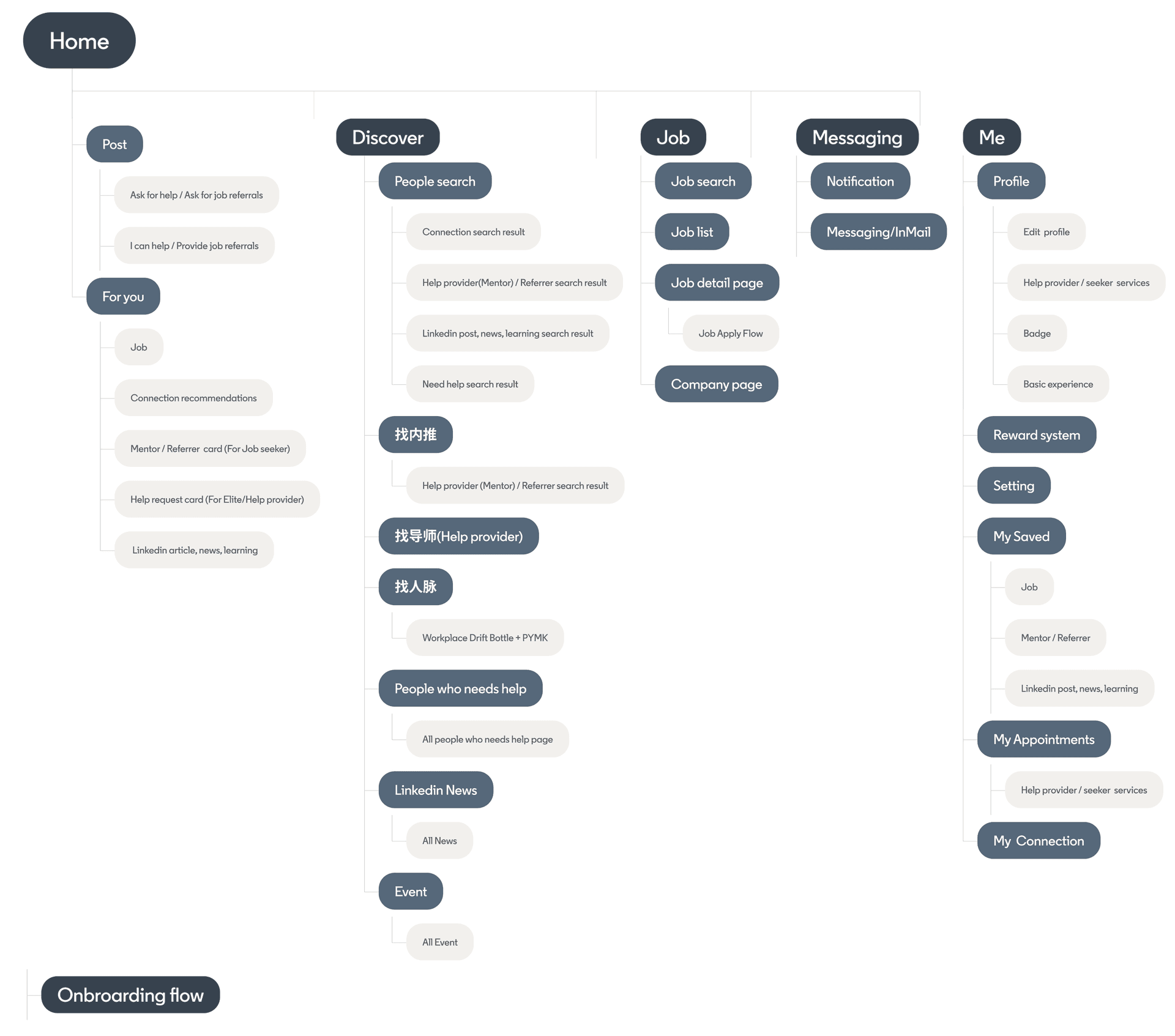
- •Owned the information architecture (navigation + content hierarchy) and core user journeys for Phase-1 MVP.
- •Partnered with UXR to frame research questions and lead synthesis workshops into actionable insights.
- •Partnered with Data Science to translate behavioral data into segment selection + metric framework.
- •Defined MVP scope and tradeoffs, aligned with PM/Eng on feasibility, and created the phased sequencing plan.
Additional contribution
Established CN design guideline ("70/30" with the global design system) and key interaction patterns to speed up delivery and maintain consistency.
FRAME
Define questions, hypotheses, success metrics (w/ UXR)

DEFINE
Frame research questions. Combine UXR insights + behavioral data (w/ DS)
EXPLORE
Generate options, evaluate tradeoffs, align stakeholders
DESIGN & SHIP
Design core journeys + IA, support MVP delivery
Cross-function Teams
Partners: PM, Eng, UXR, Data Science
PROJECT CONTEXT
Background
Regulatory-driven Feed removal
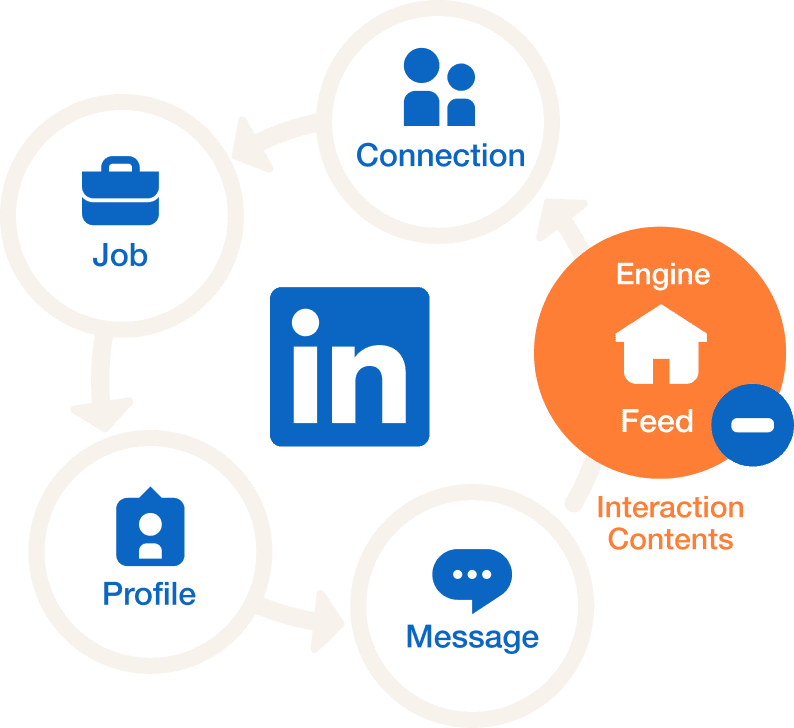
In Oct 2021, LinkedIn China removed the Feed tab—previously the primary driver of engagement and return visits through broadcast social interactions. Under the constraint that individual users couldn't publicly broadcast in a Feed-like format, content could still support discovery (e.g., curated POD) but couldn't be the primary engagement engine.
Problem
Lose Engine
Feed powered discovery and lightweight interactions that brought users back frequently. Without it, we lost a scalable way to drive repeat visits and people discovery.
Goal (North Star)
Find a New Engine
Find a New Engine to retain and engage core users.
Measure: Stabilize WAU/retention (without rebuilding Feed)
CHALLENGES
Policy Restriction
Limited time & policy constraints to redesign a new app
- •Timeline: ship Phase-1 MVP in 6 months
- •Policy: avoid rebuilding a Feed-like experience
- •Business: protect trust and stabilize WAU/retention
- •Change management: introduce new mental models while keeping LinkedIn's brand trust
“If Feed is gone,
what people-first career outcome should we build?
And what's the smallest MVP we can ship in 3 months to prove it?”
How to Measure Success
I partnered with PM to define success metrics for the MVP
1.Primary: WAU / retention
2.Activation: opt-in completion, conversation activation
3.Quality: 7D Conversation Activation (≥1 conversation)




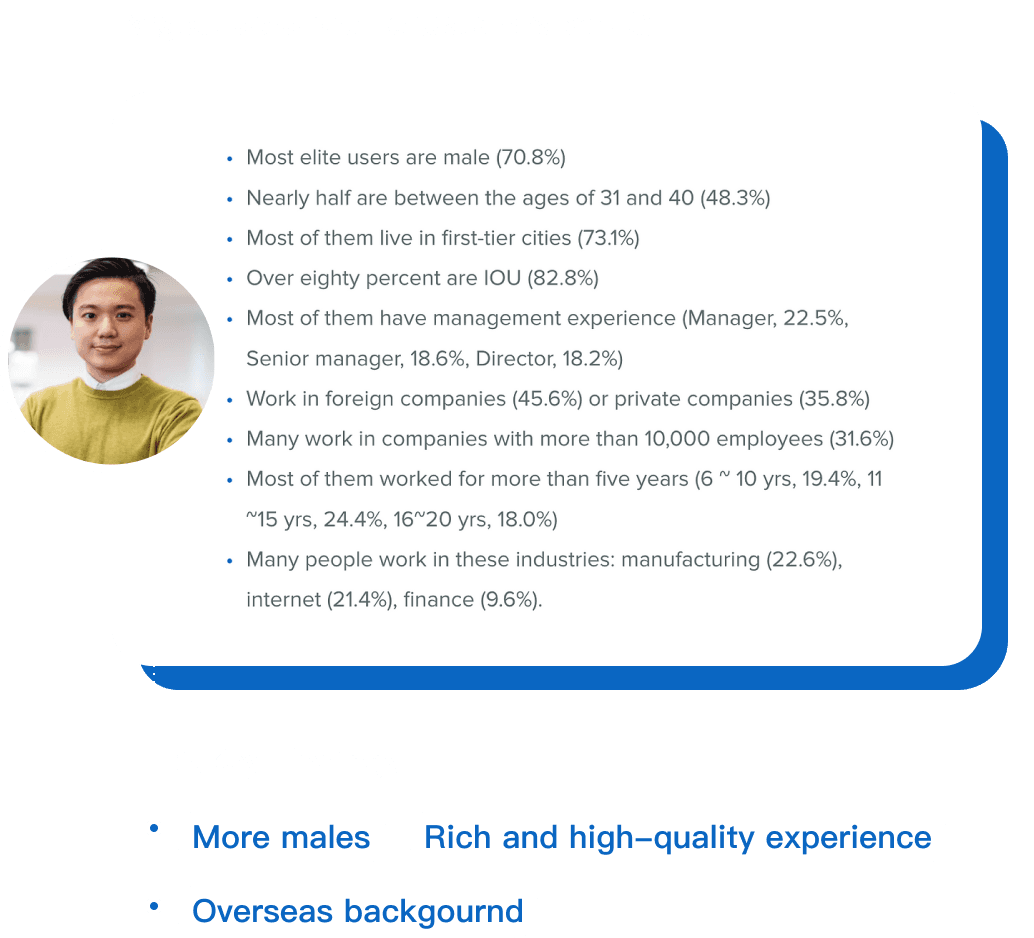
Define Elite as target users
Defining “Elite” as the target users (data-driven)
Elites, as recruiter search targeting and paid job applicants, represent a Total TAM* of 1.4 million on LinkedIn. Among them, 68K are WAU*, accounting for 36% of the total WAU, while 68K are MAU*, making up 28% of the total MAU. Notably, 95% of Elite MAU have 2-20 years of experience, with 50% of them employed in companies with 500 or more employees.
The contribution of Elites to both LTS* and active job seekers is substantial. Elite MAU alone account for 95% of InMail 7-day acceptance rates within China, driving monetization efforts. Additionally, they make up 70% of active referrers and mentors, enhancing the consumer experience.*
*WAU=Weekly Active User | *MAU= Monthly Active User | *TAM= Total Addressable Market | *LTS= LinkedIn Talent Solutions
Define the users needs by User Research
In order to get a deep understanding of target users' needs and pain points. I conducted a qualitative research with UER team and a quantitive survey with Data scientists
I collaborated with UER to define the right questions of Qualitative research (Conduct 1-1 In-depth interview (20 extreme and active users)
- 1. What goals do elite users have when coming to LinkedIn?
- 2. What actions do high-value users take most frequently?
- 3. What the pain points in career development?

78% View Profiles to Develop Career
"First, I want to know what my former colleague is doing now. Secondly, when I consider my career development path, I want to look at other people's profile to see their experiences as a reference. For example, who are working on my target position, what kind of education background, work experience, and development path they have."
 From Lynn, 36-40, Project management, Health Care
70.4% Read Content
"After opening the app, I will first look at the feed to see what information others have posted. Its timeliness is very good. If you follow many people, you can learn about hot overseas trends in various industries"
 From Hannah, 36-40, Consultant, Construction
73.1% Build Connections to Develop Career
"Many domestic and foreign industry experts or celebrities have accounts on LinkedIn. I can find the person I need, and it is very convenient to build connections on LinkedIn. We can develop our own careers and add value for ourselves. Sometime I can find interviewer in LinkedIn when preparing for an interview"
 From Gao, 31-35, Finance, Internet Industry
Exchange Resource & Enhance Influence
"I want to make connections with more peers from the same industry or relevant industry to exchange different and fresh ideas resources with each other. I have rich experience in my industry, I want to boost my repute and influence in industry to bring me more opportunities and to help me success."
From Louis, 41-45, Logistics Expert, Automobile IndustryGet professional advice & Develop Career path
"Small companies don't care much about training employees' professional skills and career development. When I encounter problems or bottlenecks in my work, I try find a mentor to ask for advice. Moreover, I also try to add connections to help me refer job"
Gail, 21-25, Marketing, Media & CommunicationQuantitative Survey
Sent a questionnaire to elite users via SMS. A total of 5239 valid samples were collected
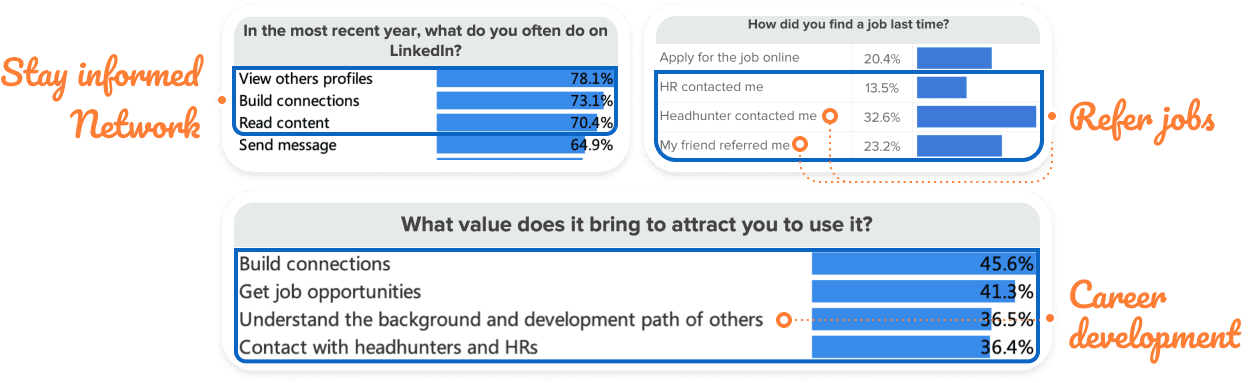

Data results of Elite WAU behavior
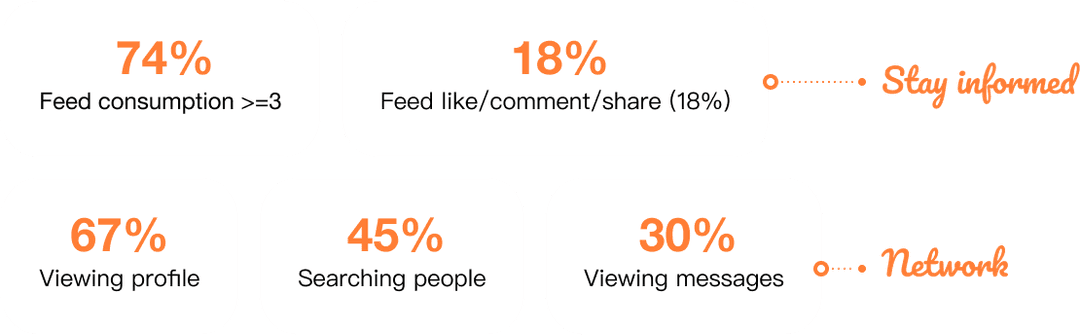
Synthesized key pattern - What do users need?
Research showed users ultimately seek career growth—reputation, reliable advice, and opportunities. Needs like staying informed, networking, and referrals support that overarching goal. Profiles are the trust layer that helps users decide who to learn from or ask for help.
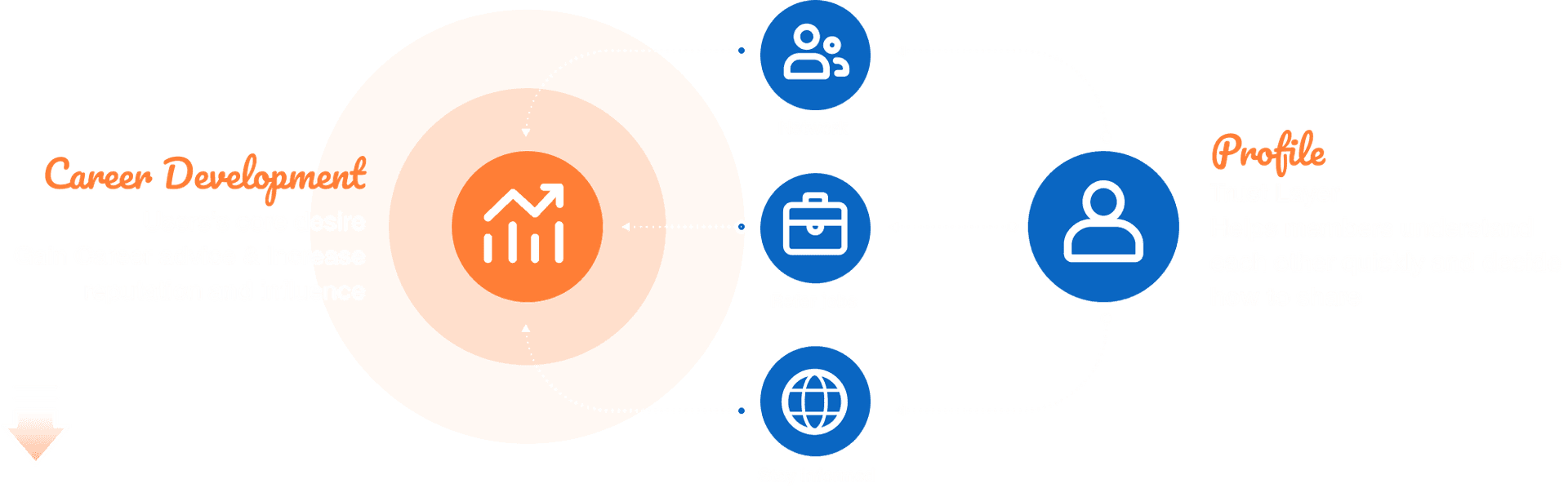
My analysis
Users pursue career growth through (1) broadcast social interactions and (2) direct, trust-based connections. With public broadcasting constrained, I identified an intent-based, trust-led interaction loop as the primary viable engine.
Competitor Research
LinkedIn's Opportunity
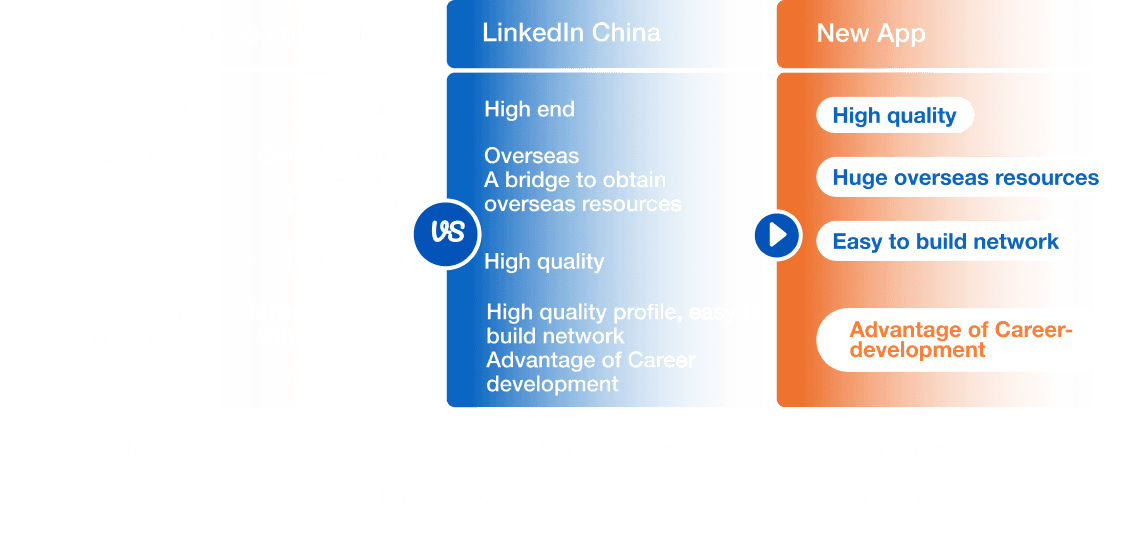
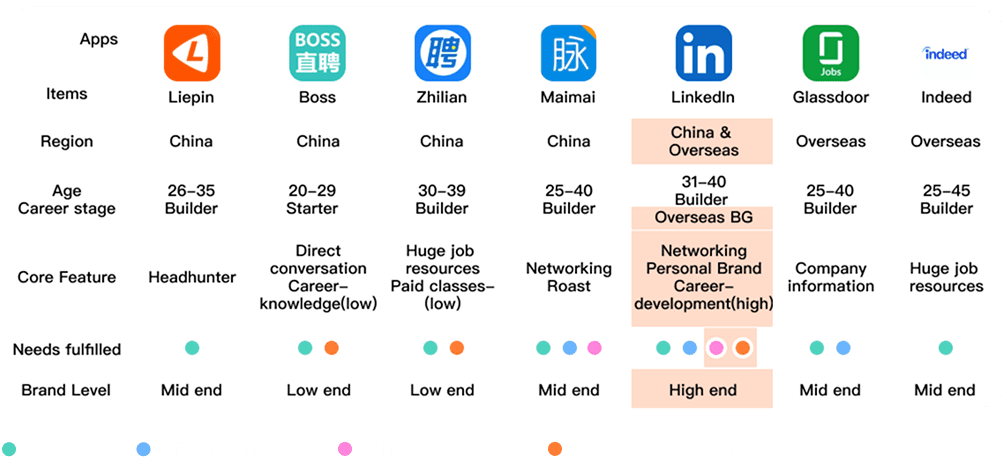
I identified the unique values and opportunity — LinkedIn's edge: quality + global access + network effects
My Insight
Local competitors have domestic job resources but lack trusted professional identity. LinkedIn's verified profiles and global resources uniquely enable high-quality career conversations.
So I focused on interaction models where verified identity and expertise power high-signal help—not broadcast posting.
“How might we replace a broadcast social feed with an intent-based, trust-led interaction loop that accelerates career growth and restores repeat visits?”
Strategic Options I Explored
Insider Referral Network
Connect job seekers with verified insiders for referrals and hiring insights (high-signal, 1:1).
Career Help Community
An intent-based loop (intent → match → conversation) for scalable advice/mentorship/referrals.
Learning Hub (structured, expert-led PGC)
Curated, expert-led classes (LinkedIn Learning style) surfaced via topics/search—not a user-generated feed.
I evaluated three strategic options
Criteria: Market differentiation × User coverage (plus feasibility & speed-to-validate in 3 months)
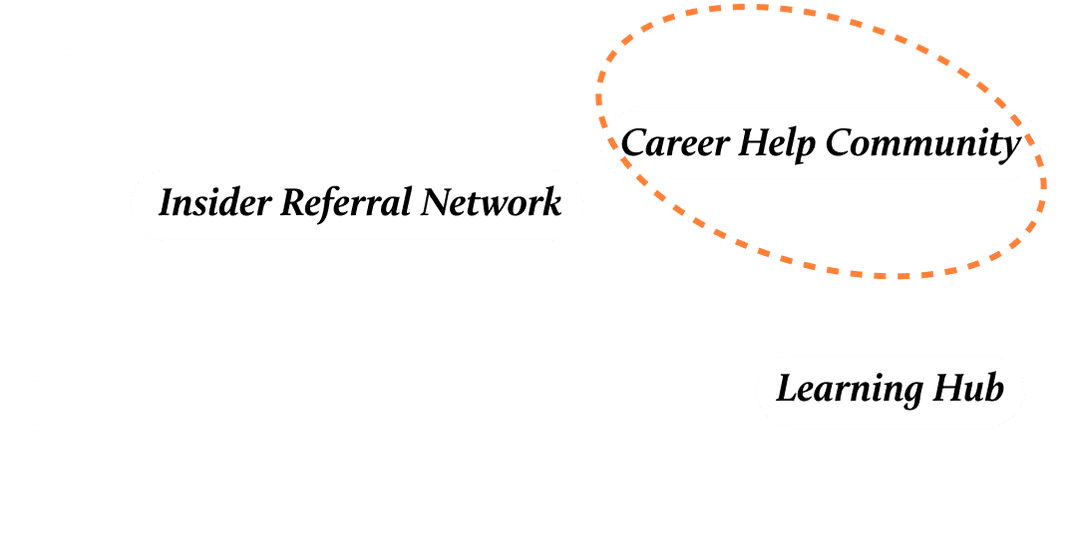
I recommended Option B Career Help Community
- Best balance of coverage + defensibility while fitting the no-public-broadcast constraint
- Fastest path to validate in 3 months with clear metrics (opt-in + 7D conversation activation + WAU/retention)
Create a new LinkedIn China's user workplace experience to help users gain career development

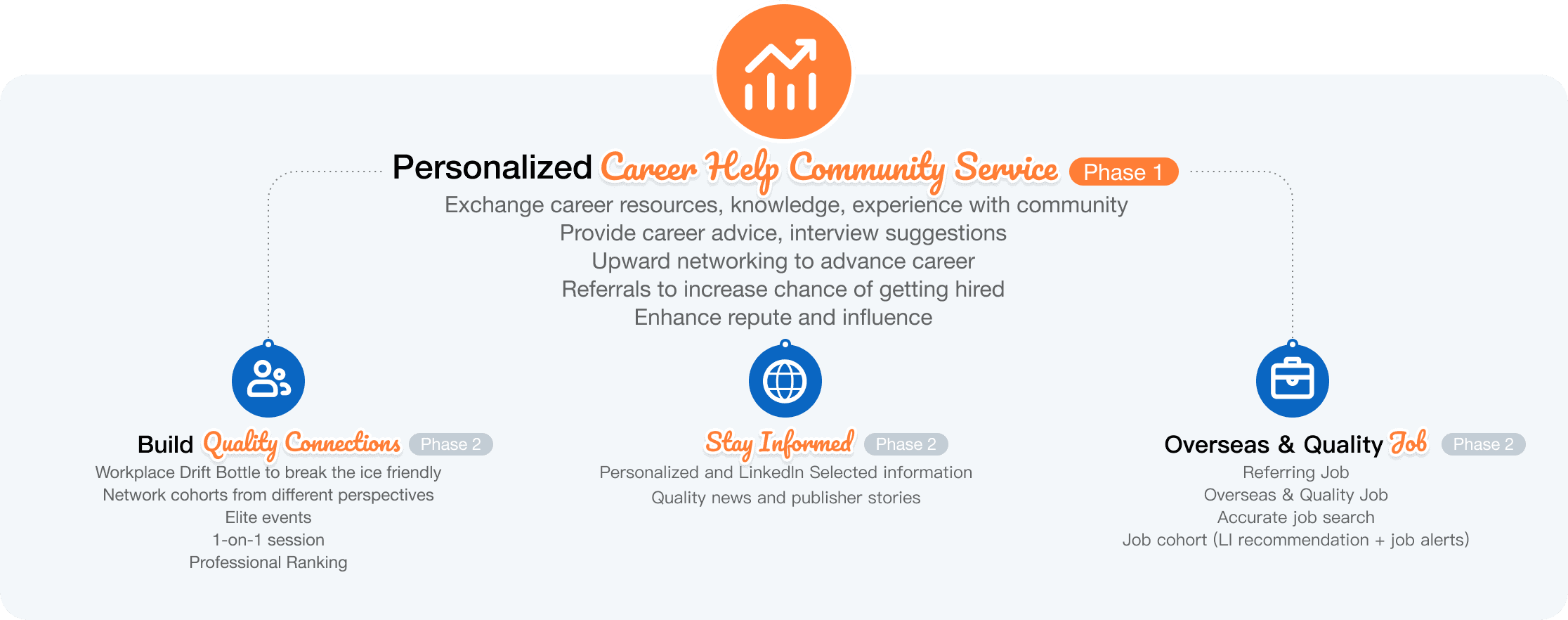
I made Career Help Community the core engine (Phase-1)
I designed supporting modules to strengthen discovery, supply, personalization, and sustained engagement (Phase-2/3).
One-Stop-Shop for career development
1.Career Help Community - Core loop
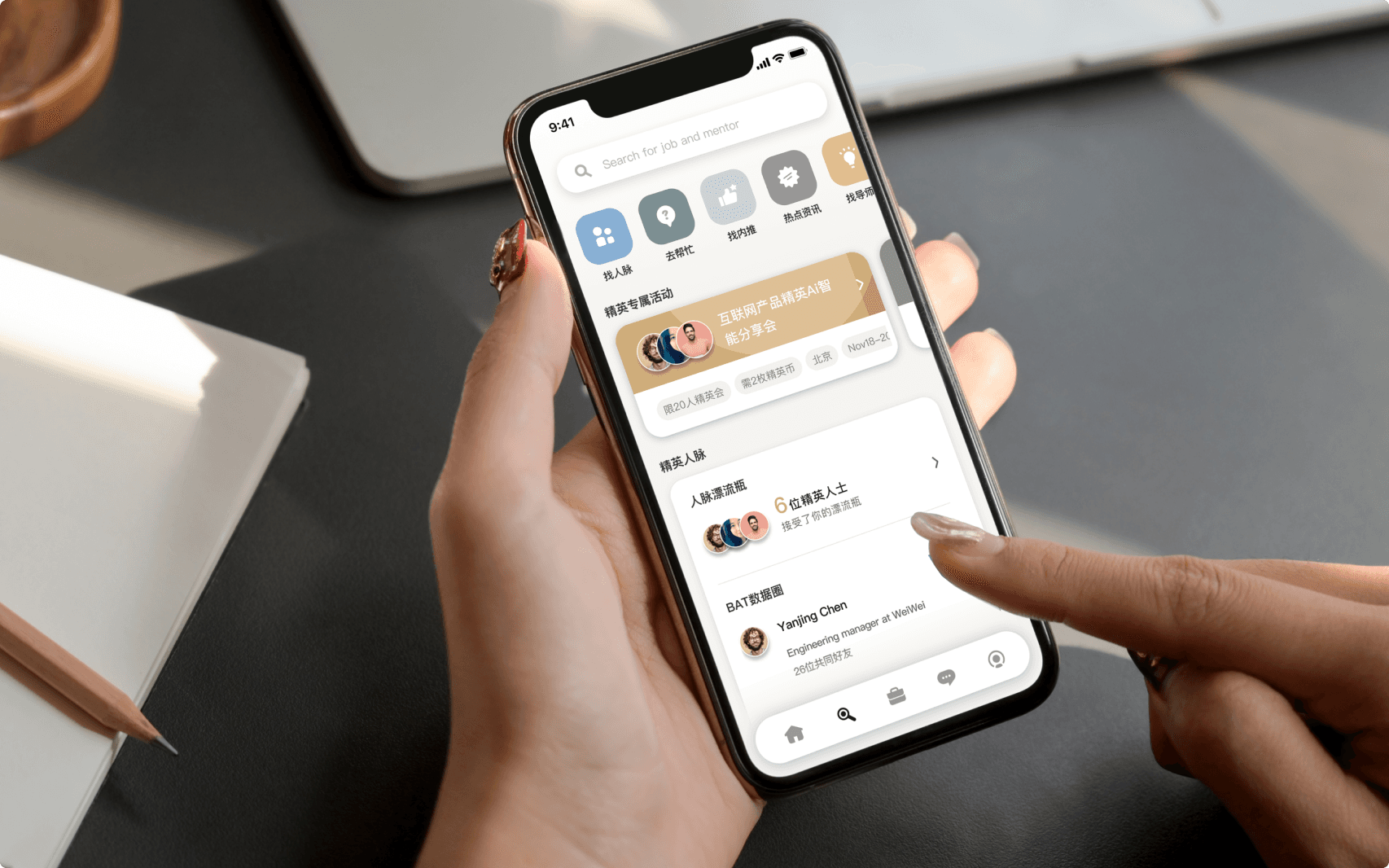
To replace broadcast feed interactions, I needed the smallest trust-led loop that creates repeat engagement without public posting. I shipped the Intent-based loop: Raise hands → Match → Start 1:1 conversations.
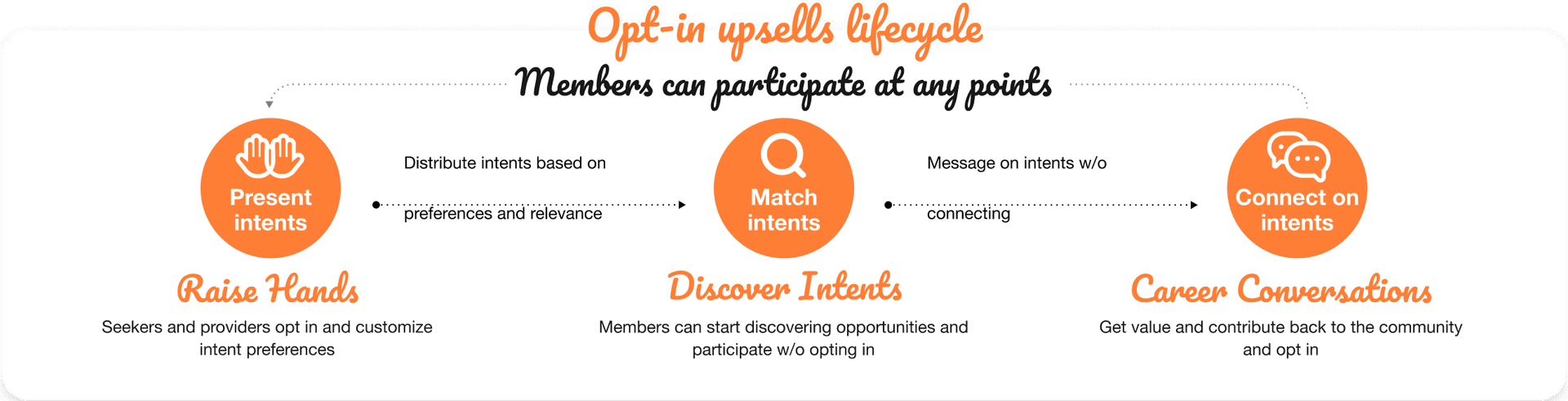
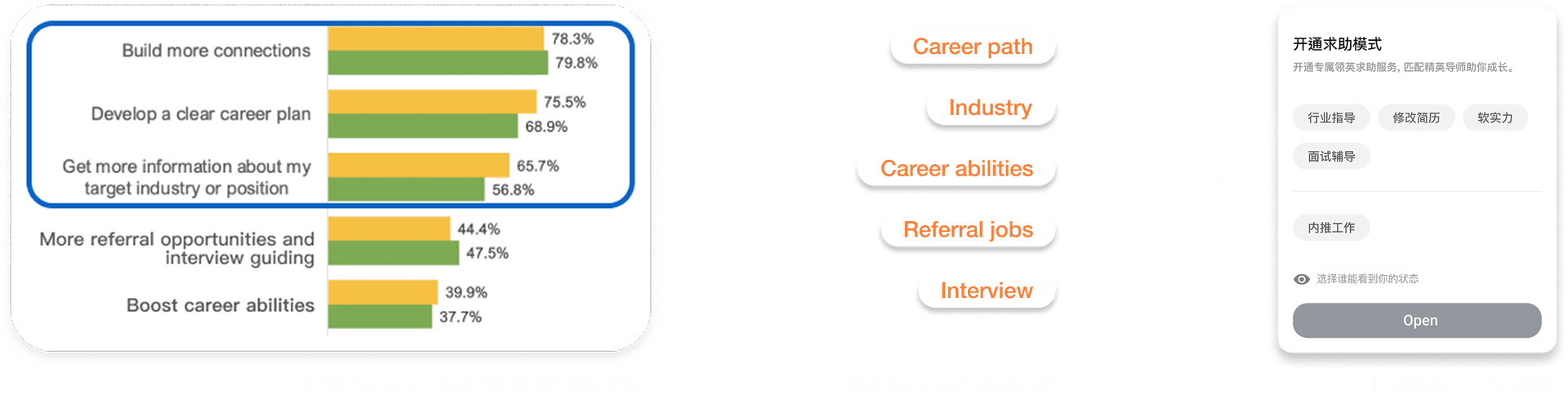
Members can customize intents and help each others with sharing knowledge, experience and job referrals.
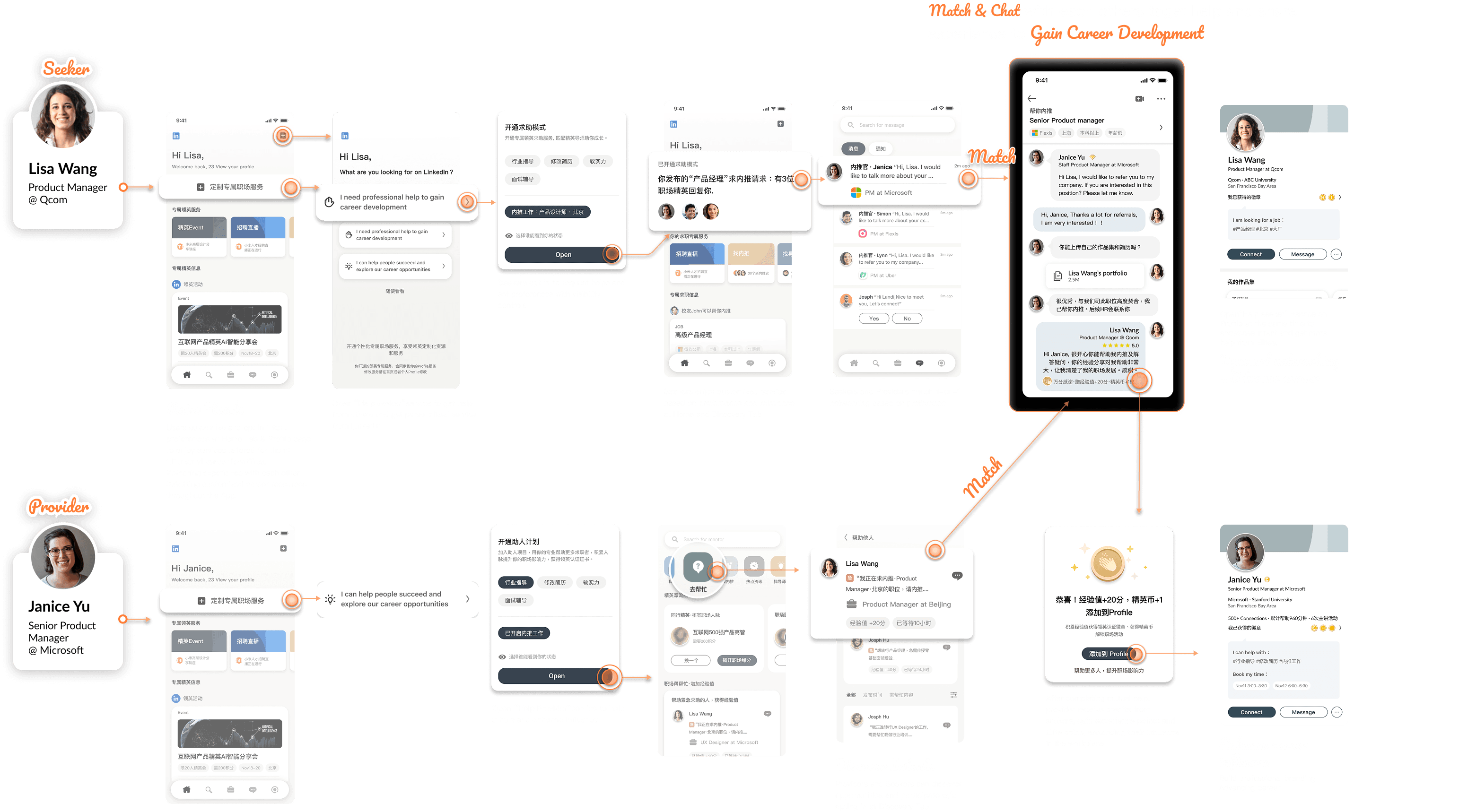
Design Flow
Seekers & Providers' mutual help Flow (end-to-end)
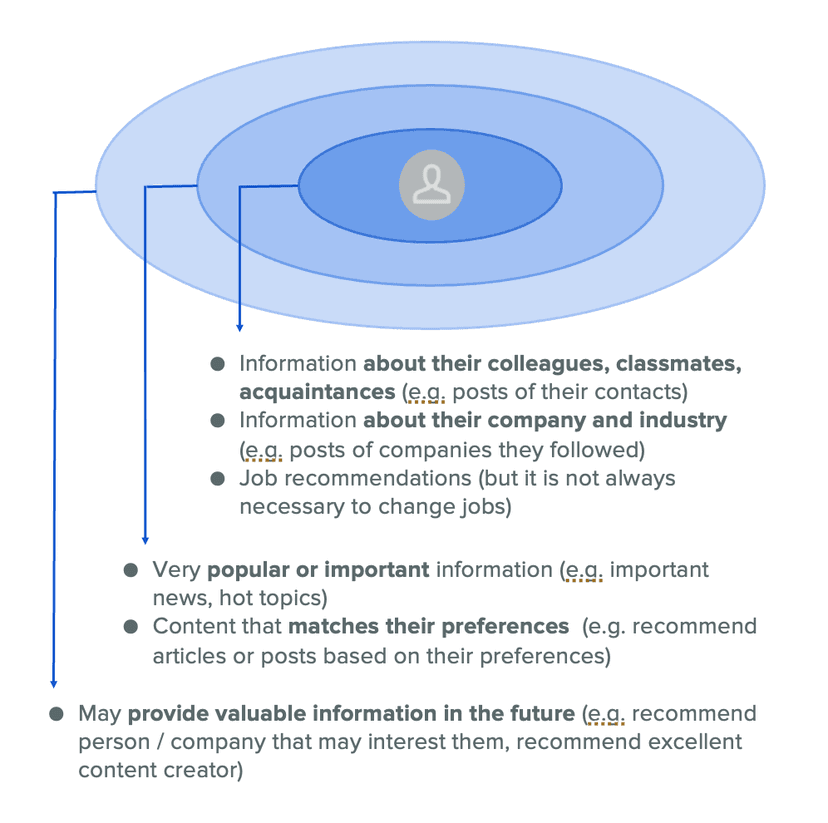
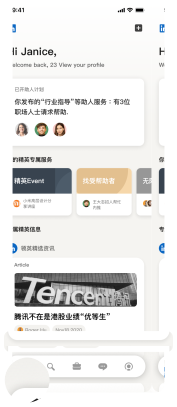
Stay Informed (Phase-2)
Stay informed with quality news and publisher stories
Meets users need and strengthens return reasons + conversation context
In early research, I found users valued "staying informed," but the need was vague
So I ran a focused study to clarify what information matters and why
I designed a relevance-based PGC feed surfaced via topics/interest signals, giving users lightweight context and better talking points for Career Help conversations.
Personalized resources based on preferences (Phase-2/3)
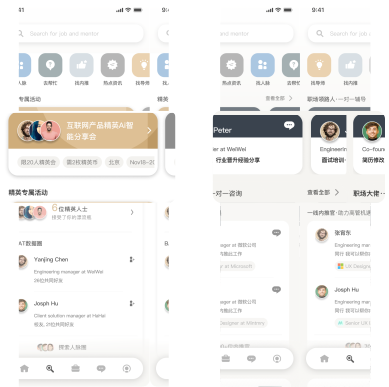
Provide personalized resources for users based on the Help Provider or Seeker services set by users.
Strengthens routing + conversion
Discover pillar
For Help seeker
Customized career resources on preferences
Information, events, connections, referral jobs, career help service.
Prioritize these kinds of resources based on personal preferences, users behavior and data insights

For Help provider
Corespondent resources tailored for help providers, helping senior professionals build upward network with Elites
(Elite events)

For help seekers, help them upward network with senior leaders to advance career (1-on-1 session with senior leaders)
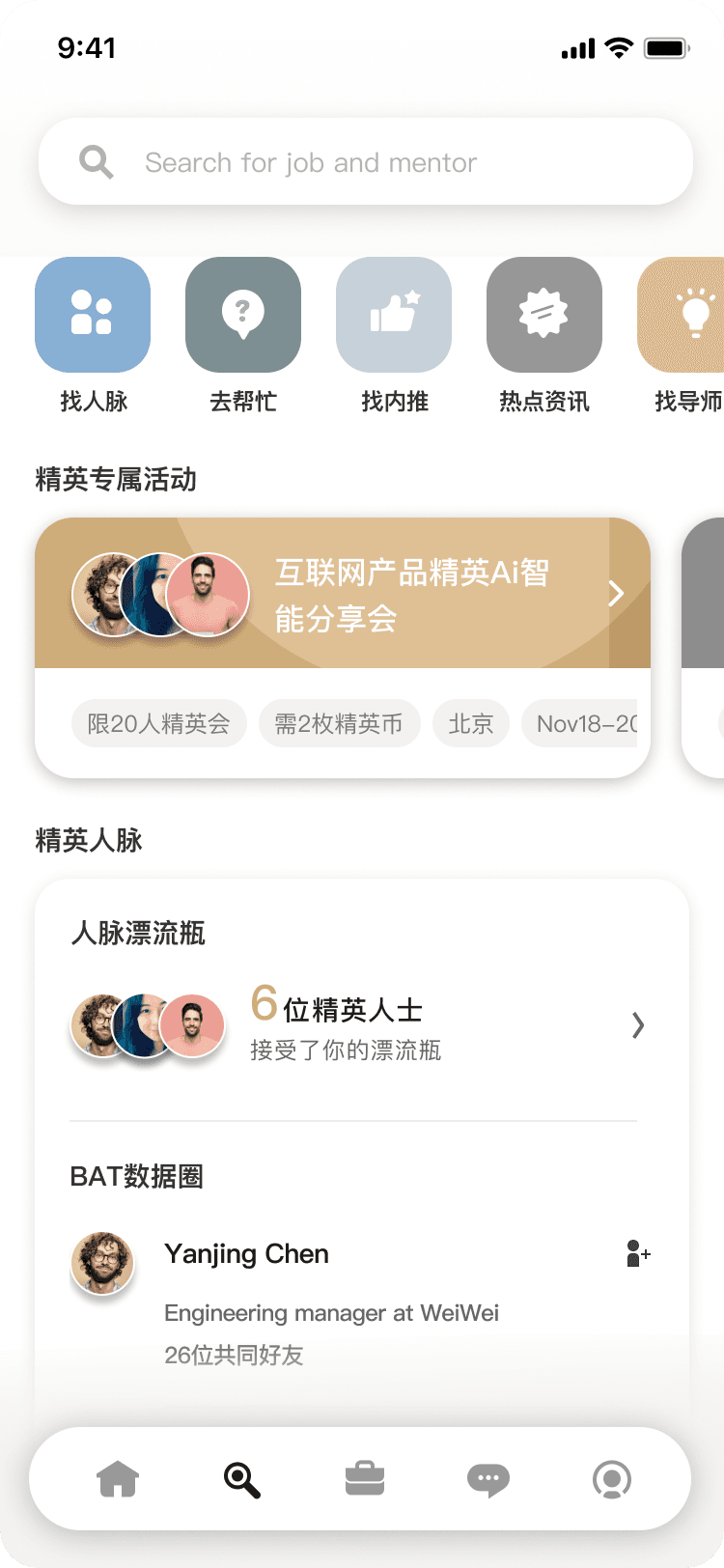
Build networks (Phase-2)
Cohort discovery + icebreakers to improve match quality and increase conversation starts
Strengthens discovery + match quality
Customize network matching preference
People You May Know
Network cohorts
(e.g. 阿里校友会, BAT产品人)
I refine the key findings from the user testing
Peers in the industry (57.1%)
Industry experts or celebrities (53.4%)
Headhunters (44.1%), employees of the Target company (43.2%)
Alumni (35.8%)
Workplace Drift Bottle
Match 1-on-1 networking based on preference and interested topics
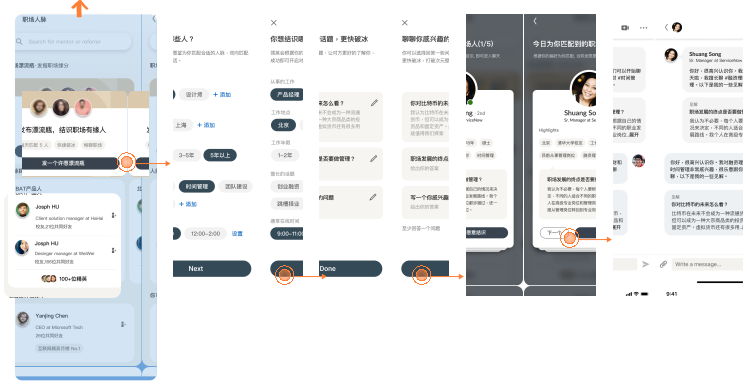
Professional circle & Ranking Superstar
(The card entry point is in the Discover pillar)
Discover and build familiar and quality network, exchanging career resources, advancing career
Ranking in your industry
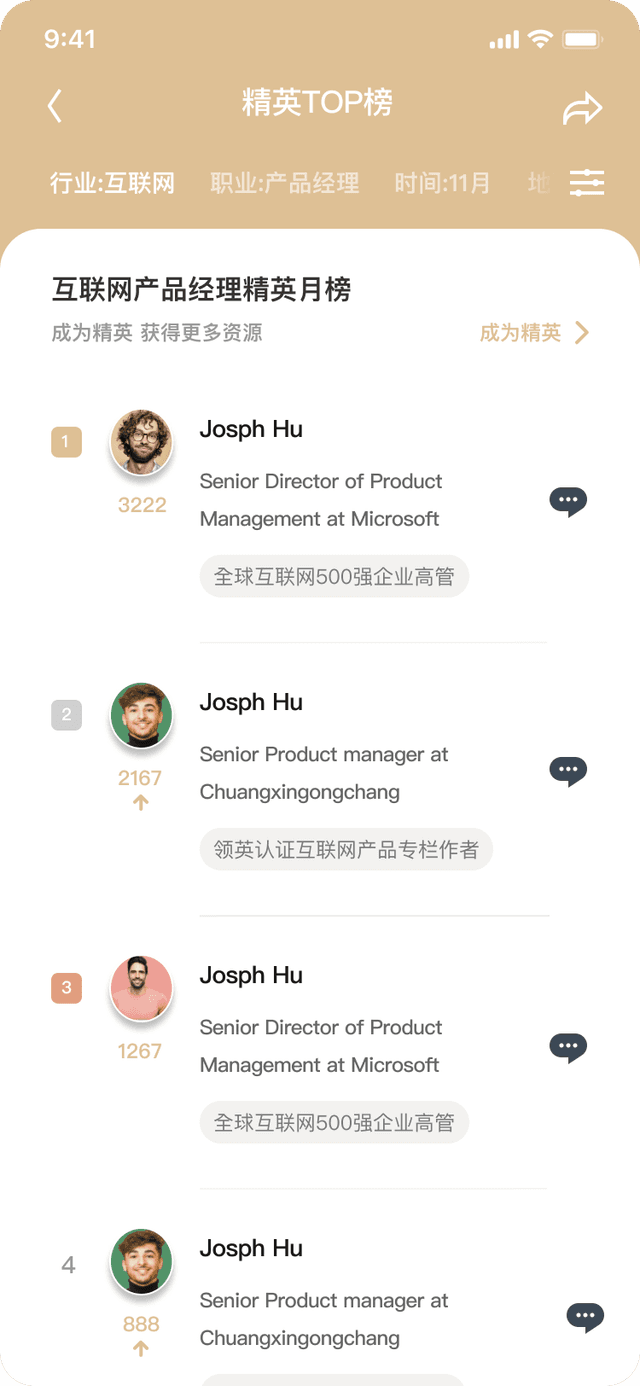
Professional circle on multi-dimension relationships
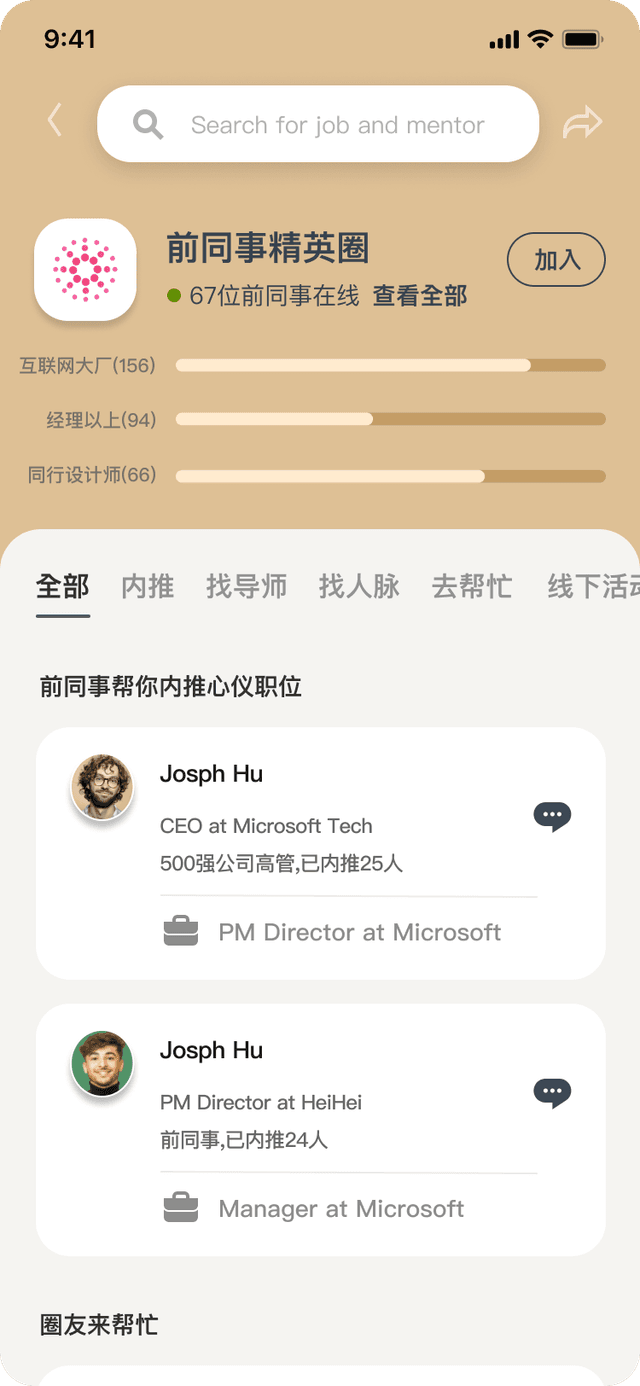
Incentives + Credibility (Phase-3)
Passing Love & Pay-it-forward rewards incentivize elites to keep providing values to community
Strengthens supply health + trust
Personal Career Branding
Customizable profile page meets different needs for building strong personal branding and enhancing career influence. Meanwhile, credibility highlights (badges/reviews) to sustain supply and protect trust
Easy customizable profile with templates (e.g. present portfolios, knowledge expertise, and etc.)
Strong personal credibility with earned badges, contribution highlights
Let community know "Open to X" intent and preference
Present review from communities to endorse values members provided
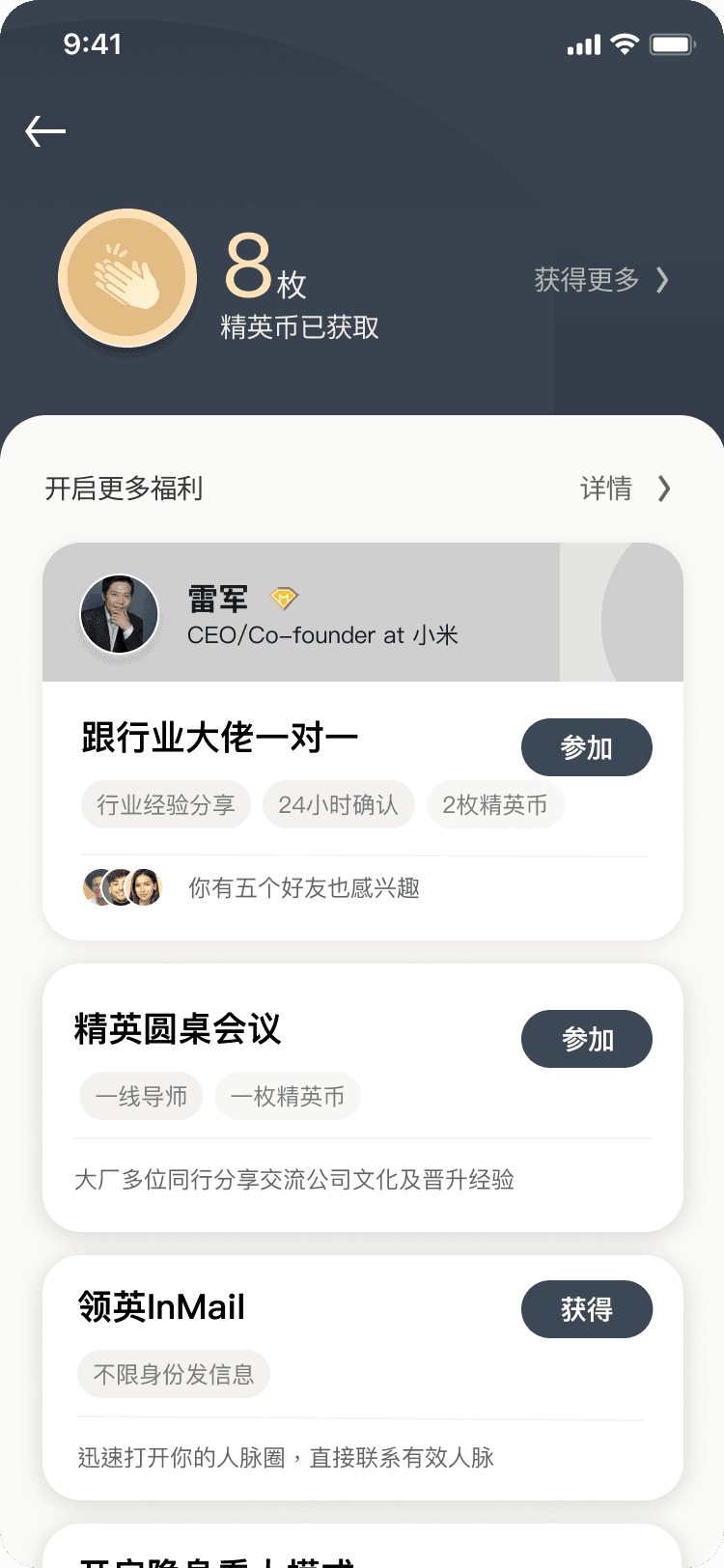
Incentive mechanism
Passing Love & Pay-it-forward rewards incentivize elites to keep providing values to community
Use credits to unlock additional features and exclusive benefits
- •Unlock exclusive benefits
- •Upward networking with senior leaders
- •Exclusive events
- •Unblock premium networking features
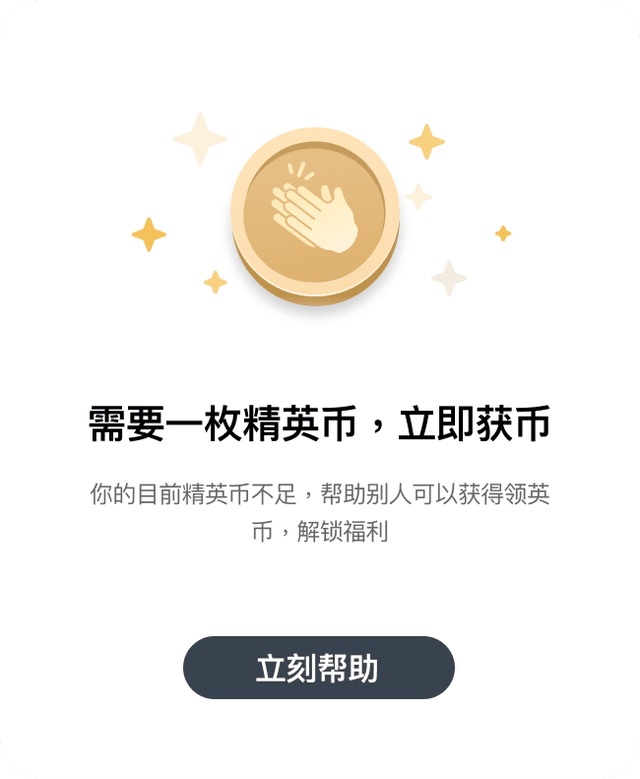
Unlock additional opportunities when running out quotas
Set a New Design Principle and Design structure
Define new design principles to ensure consistency among the design and the business goal and user requirements
Redesign a New Design Principle for New App
Redesign the structure of New App
DIVERSE USERS & NEEDS
Active users are elites, active job seekers and other professionals, they have multiple needs

PERSONALIZATION
Customize intents and preferences Recommend personal resource by users preferences, behaviors and data insights Customize network matching preferences
CORE USERS' NEEDS & NEW APP'S CORE VALUE AND GOAL
Core need of users is to build network and develop career. So New App aims to help users with building network to advance career

SENSE OF COMMUNITY
Mutual help community, Workplace Drift Bottle to create chances of building networks.
BRAND & TONE
Aiming to create Mutual help community-centered career ecosystem

WARM, LIVELY, FRIENDLY AND CRISP
Card-Based UX & UI Design Clear Structure and Information Hierarchy, Responsive Design.
DEVELOPMENT FEASIBILITY & SUSTAINABILITY
Considering development costs. Facilitates short and long-term planning, cross platform, including iOS, Android, Web.

HIGH SCALABILITY & FLEXIBILITY
Redesign design components and guideline Responsive Design to fit iOS, Android, Web.
CHINESE USABILITY & PARTICULAR SITUATION
Chinese local policy restriction & Usage habit of local users: 1.Restrictions on free speech 2.Chinese career culture, like Chinese professionals are more shy to break the ice 3.They value building connections to gain resources

LOCALIZATION & USABILITY
Restrictions on expression freedom by local policy in China. Chinese career culture: Chinese professionals who aim to build networks are more likely to be shy and hesitant to break the ice. So create opportunities to help people discover each other, match, and break the ice. Privacy settings. China Customized User Friendly Pattern and Components